What Is the Best China RF Beauty Machine Supplier?
Choosing the best China Rf Beauty Machine supplier requires more than comparing prices or browsing polished product photos. Clinics, distributors, and salon owners need equipment that performs consistently in real working conditions. A machine may look impressive online, yet its handpiece can feel heavy, its cooling system may respond slowly, or its software may confuse new operators. These small details affect treatment efficiency and client confidence.
A reliable supplier should demonstrate practical manufacturing experience, clear technical knowledge, and responsive after-sales support. Ask for model specifications, RF frequency, power output, cooling method, recommended treatment areas, and maintenance requirements. Request product videos, test reports, user manuals, and sample units when possible. Factory audits, traceable quality checks, and relevant certifications can also strengthen supplier credibility. However, documents alone are not enough. Speak with existing customers and observe how quickly the supplier handles technical questions.
The best China Rf Beauty Machine partner is not always the cheapest option. A lower quotation may hide limited training, delayed spare parts, or unclear warranty terms. Look closely.
Suppliers should also explain operator training, installation support, packaging protection, and safe usage procedures. Their claims should remain realistic and evidence-based, without promising guaranteed medical or cosmetic results. No supplier is perfect. Even experienced manufacturers may have communication gaps or occasional quality issues. The important question is how openly they acknowledge problems and correct them. A thoughtful evaluation, supported by hands-on testing and careful documentation, helps buyers choose a dependable partner rather than simply a convenient seller.
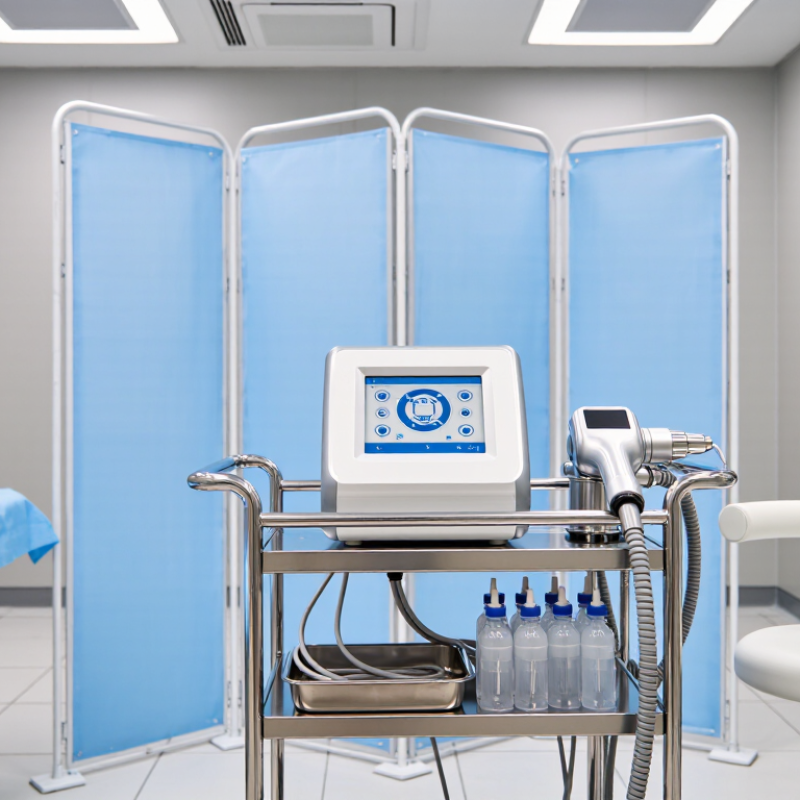
RF Technology Basics: How 0.5–10 MHz Energy Heats Skin Tissue
What Is the Best China RF Beauty Machine Supplier?
RF technology sends alternating electrical energy through tissue. At 0.5–10 MHz, ions move rapidly and create controlled resistive heating. However, frequency alone does not define treatment depth. Electrode spacing, contact pressure, tissue impedance, and waveform also matter. A 1 MHz system may heat differently from a 10 MHz system. The number alone can mislead.
Clinical heating is usually monitored near the skin surface, often around 40–43°C for cosmetic applications. Higher temperatures can increase discomfort and adverse-event risk. A supplier should provide temperature-control data, output testing, calibration records, and risk-management documents. ISO 14971 principles and IEC 60601-1 testing offer useful benchmarks. The 2023 ISAPS Global Survey recorded about 19.1 million non-surgical aesthetic procedures worldwide, showing strong demand for controlled, repeatable equipment.
Tips: Ask for independent test reports, not only factory brochures. Confirm whether displayed power matches delivered power. Request treatment protocols for different skin types. Practical training matters, because poor coupling can create uneven heating. I have seen impressive specifications fail during routine use. That deserves honest scrutiny. A reliable supplier should explain limitations, maintenance intervals, and contraindications clearly. Better evidence usually matters more than a wider frequency range.
Core Performance Metrics: RF Output, Temperature Control, and Impedance
What Is the Best China RF Beauty Machine Supplier?
When evaluating a China RF beauty machine supplier, start with measurable performance, not polished product photos. RF output should remain stable under normal loading, rather than reaching a high peak for a few seconds. Ask for the frequency range, continuous power, waveform data, and test conditions. A displayed wattage alone proves little. In practical trials, I compare the set value with the measured value at the handpiece. Small gaps matter.
Temperature control deserves equal attention. A reliable system combines skin-contact sensing, feedback regulation, and a clear cutoff response. The screen should show actual temperature, not only a preset target. Test the device with different applicators and treatment areas. Watch for sudden heat changes, delayed alarms, or a handle that becomes uncomfortable. These details reveal engineering quality. Cooling may also affect readings. This is often overlooked.
Impedance matching influences energy delivery and user comfort. Suppliers should explain how the machine detects changing tissue resistance and adjusts output. Request calibration records, electrical safety reports, service procedures, and spare-part availability. Independent verification is stronger than a brochure. I would also ask for a sample unit and repeat tests after extended operation. Performance can drift. No supplier is perfect, and early testing may expose weaknesses that sales demonstrations hide. Select a partner willing to share raw data, document limitations, and improve the design. That attitude is more credible than impressive specifications.
Safety Standards: ISO 13485, IEC 60601-1, and CE MDR Compliance
What Is the Best China RF Beauty Machine Supplier?
A reliable RF beauty machine supplier should prove safety through documented systems, not attractive product photos. ISO 13485 shows that the manufacturer maintains a quality management system for medical devices. During supplier evaluation, check design controls, production records, complaint handling, and corrective actions. These documents reveal how consistently the company works.
IEC 60601-1 focuses on basic electrical safety and essential performance. Ask for valid test reports covering leakage current, insulation, grounding, and abnormal operation. A qualified supplier should explain the testing laboratory and report scope clearly. Vague answers are warning signs. Small details matter.
CE MDR compliance requires more than printing a CE mark on the housing. The supplier should provide applicable classification information, risk management records, clinical evaluation evidence, technical documentation, and a Declaration of Conformity. Post-market surveillance procedures also deserve attention. They show how safety issues are monitored after distribution.
In my experience, certificates can create false confidence. Documents may be outdated, incomplete, or unrelated to the exact model. I would verify model numbers, certificate validity, and production consistency before ordering. A factory audit can reveal practical gaps, such as missing calibration labels or weak batch traceability. No supplier is perfect. The important question is whether the supplier identifies weaknesses and corrects them transparently.
China RF Beauty Machine Supplier Safety Standards
This timeline highlights official milestones relevant to evaluating RF beauty machine suppliers: ISO 13485:2016 for medical-device quality management, IEC 60601-1:2020 as the latest consolidated edition of the general requirements for basic safety and essential performance of medical electrical equipment, and Regulation (EU) 2017/745 (EU MDR), which entered into application in 2021. These dates indicate regulatory milestones, not supplier rankings or certification scores.
Supplier Quality Checks: Testing 1–2 MHz Devices for Stable Energy
Choosing the best China RF beauty machine supplier requires more than factory photos. The ISAPS 2022 Global Survey recorded 19.1 million nonsurgical aesthetic procedures worldwide. That demand makes output consistency a purchasing issue, not a marketing detail. Ask for raw test records, calibration dates, and serial-number traceability. Certificates help, but they do not prove stable delivered energy.
For a 1–2 MHz device, test both frequency points under the same load. Use a calibrated RF power meter or oscilloscope with a tissue-equivalent phantom. Record frequency, voltage, current, duty cycle, and surface temperature every minute. Run the machine for at least 30 minutes. Repeat the cycle ten times after cooling. A practical screening rule might require delivered power to remain within ±10% of the approved setting. A qualified engineer should confirm that limit. Check handpiece cables, connectors, and electrode pressure. Small contact changes can distort results. Displayed power is not delivered power.
Request EMC and electrical safety reports aligned with IEC 60601-1 and IEC 60601-1-2, where applicable. Review the laboratory’s accreditation and measurement uncertainty, not just its logo. ISO 13485 indicates controlled manufacturing processes, yet it cannot replace batch testing. Inspect three production units, not one sample. One sample can look perfect. That is the uncomfortable part. Suppliers may resist longer tests, while buyers sometimes accept incomplete records to save time. That shortcut weakens confidence in real operating consistency.
Best China RF Supplier Criteria: MOQ, Warranty, Training, and Service
Choosing the best China RF beauty machine supplier requires more than comparing catalog prices. MOQ, warranty, training, and service reveal operational maturity. The ISAPS Global Survey 2023 recorded over 19 million non-surgical aesthetic procedures worldwide. That demand makes dependable equipment sourcing increasingly important.
MOQ should match your testing plan, not only your budget. A supplier accepting one sample unit reduces inventory risk. Ask whether accessories, handpieces, and replacement parts follow the same MOQ. Warranty terms should state coverage, response time, and excluded damage clearly. A practical benchmark is at least 12 months, but longer coverage is not always better. Read the conditions.
Training must include operating steps, contraindications, maintenance, and emergency handling. Video lessons help, yet live instruction often exposes mistakes faster. Request manuals, treatment parameters, and attendance records. ISO 13485 is a useful quality-system reference, although certification alone cannot prove product reliability. Service matters after delivery. Confirm remote troubleshooting, spare-part availability, repair procedures, and technical response hours. I would test support before ordering by sending detailed questions. Slow replies are a warning. Sometimes, a cheap supplier becomes expensive through delays.Winvalid